
What Actually Goes Through Your Mind During a Marathon?
My wife asked me this the other evening:
“What do you actually think about in all those hours when you ran the Dubai marathon?”
It’s a simple question, but my answer wasn’t. Because it’s not one thing. It’s a whole ton of things. And those things change constantly as you adapt to different phases of the run, as well as what is going on around you.
The First 10km — Holding Back

The first part is all about restraint. When the race started loads of people bolted off at speed. I knew something that they didn’t – that I would be seeing many of them again.
The temptation to go fast with the crowd is high, but your strategy is formed already through months of training and this ensures that you have the clarity of thought to focus only on that strategy. You do question yourself: “Am I starting out too slow?” but you shut that noise off and go back to your plan.
Some of those who flew off I already started seeing walking around the 4km mark. Meanwhile, I was still fresh.
10–24km — Settling In
This part feels manageable. You have covered more than 24km in one run multiple times in your training – often lonely 5am runs on Sunday mornings – a bit like in the first Rocky film – you leave the house in darkness whilst the rest of the city is asleep.
Whilst there is nothing unfamiliar here during this phase of the run, mentally you are working non-stop. You have your fuelling strategy, you have your hydration strategy, you are managing your heart rate, and ensuring you are topped up with electrolytes – and staying as cool as you can whilst the sun is coming up.
24–40km — Quiet Control
At this point, you start thinking: “I can run what’s left.” and you actually don’t think about what distance you have covered up to that point, only what is left.
You start to anticipate the possibility of hitting the wall. When you feel a bit tired like I did around the 34km mark you tell yourself there is no wall. In fact I shouted it out loud when I ran alongside one of my work colleagues as he started to flag – much to the amusement of the spectators I was passing at the time.
This is the point where those long training runs matter, on those early Sundays where you glanced down at your Garmin and saw ok I’ve only got 5km left, I can run that. As you see every kilometre marker you chalk down what’s left and repeat that thought “I can run what’s left.”
40–42.2km — The Reality + The Electrolyte Disaster

For me at the 40km mark the wall came. It doesn’t creep up on you, it just hits you. From nowhere. Your legs feel like jelly. Every muscle tightens.
Doubts begin to take hold. You think: “I could just walk this last part.”
That thought is very real, it’s tempting, nobody would know that you walked that last part.
For me, it was made worse by a mistake — I had dissolved my electrolyte tablets accidentally while pouring water over myself around the 20km point. Looking back, that is why the wall came at 40km as everything else in my plan was spot on.
But in that moment, it doesn’t matter why. It just gets hard. And you have to find a way to handle that.
The Finish
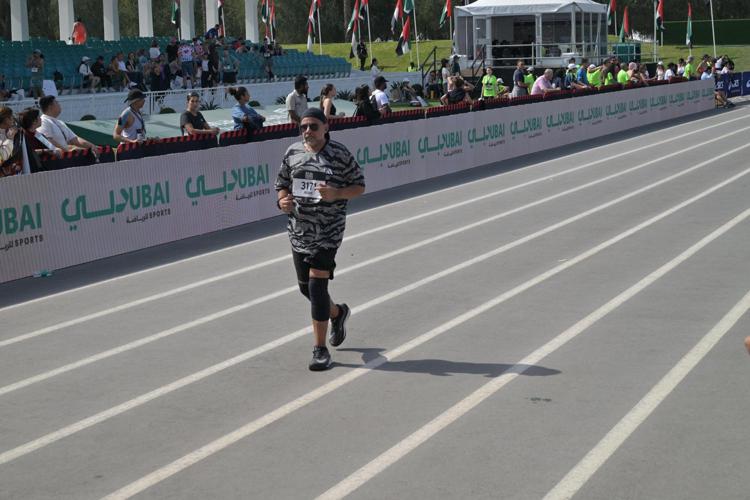
When you cross the line, it hits you. There’s a whole flood of emotion. Every kilometre you ran during training, every early morning, every niggling ache and pain, every word of encouragement from those around you – it all culminates in that moment you cross the finish line. You have to savour that moment and the achievement it represents.
The Conversation in Your Head
Throughtout the run you do talk to yourself. Several times I actually laughed out loud when thinking to myself: “What kind of idiot volunteers for this?”
Laughing about it actually improves your mood as you know you’re in it now, and there’s no backing out, you have to go forwards. Until the very end.
Wrap Up – During the Run – Decisions Never Stop
You’re not just running. You’re constantly making decisions on the fly:
- adjust your effort based on heart rate
- manage hydration
- time your fueling
- deal with heat
To help mitigate the heat issue I trained deliberately in the sun to understand what heat fatigue feels like and then learn how to fight through it. And it paid off, as on the day itself the sun was a lot hotter and came up a lot earlier than was forecast. So how it felt wasn’t new to me.
I only seriously thought about walking in the last 1–2km. But I didn’t. Partly because I had raised money for the charity Forever Angels — who look after orphans and vulnerable children in East Africa. Stopping would have felt like letting them down, and cheating all the people that donated to the cause. And partly because of the training.
You don’t go through all of that to walk the last part.
The lesson here is that running a marathon is a masterclass in personal discipline – not only on the day itself, but in the months leading up to it – valuable lessons that can be used in your daily life both at work and at home.
Having said straight afterwards that I would never run another marathon again I have decided in the last few days that I will be going again next year, and will do it even better than before.